 By Baxter Overman | April 16, 2026 in
To dry your car safely without scratches or water spots, use a clean microfiber drying towel to gently remove water from the surface, then use air or a blower for tight areas like mirrors and trim.
Most scratches during drying come from dragging dirt across the paint, so using the right technique matters just as much as the towel.
In this guide, I’ll show you exactly how to dry your car step by step using simple tools.
Why drying your car properly matters
Drying your car the wrong way is one of the fastest ways to create swirl marks or light scratches in your paint.
Scratches can happen while drying your car when:
- Dirt is still on the surface
- Too much pressure is applied
- The wrong towel is used
Even a clean-looking surface can still have small debris that gets dragged across the paint during drying.
That’s why using the right technique matters just as much as the towel itself.
Step 1: Start with a clean, rinsed surface
Make sure your car is fully washed and rinsed before drying.
Step 2: Use a microfiber drying towel
Gently blot or glide across the surface using light pressure to absorb the water. A slightly damp microfiber towel usually works best.
A completely dry towel can create more friction on the surface, especially if there’s any leftover debris.
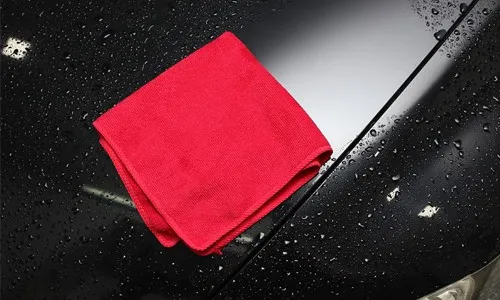
Tip: Lightly mist your towel with water or a drying aid before using it.
Step 3: Work from top to bottom
Work from top to bottom to prevent water from dripping onto dry areas. You can use a simple nonslip step ladder to dry the roof of your car. They’re lightweight, easy to store, and helpful for reaching areas that are too high to dry safely by hand.
Step 4: Use air in tight areas
Blow water out of mirrors, trim, and crevices to complete the drying process. Since water can mix with pollen or dirt and dry later, a portable dryer designed for car detailing or a compressed air tool helps force water out so you can absorb it right away.
In my experience, this becomes much more effective if your car is waxed or coated, since water beads up and is easier to blow away.
Step 5: Do a final check
When your car is completely dry, do one final walkaround to ensure all water beads are removed. If you plan to wax or add protection later, it’s best to wait a few hours to ensure the vehicle is 100% dry.
What actually works (and what doesn’t)
In most cases, you don’t need multiple tools to dry your car safely.
A single microfiber drying towel will handle most of the job if the car is clean.
Where people run into problems is:
- Using too much pressure
- Drying a car that still has dirt on it
- Using cheap or worn-out towels
In my experience, poor technique, including rushing the process, often leaves scratches when drying a car — not the towel itself.
Why microfiber is great for car drying
In general, plush microfiber towels are great for drying because they’re typically blended with a soft, absorbent material called polyamide, commonly known as nylon. And yes — cotton is absorbent too, but it’s too rough to use on a clear coat. Plus cotton tends to lint!
Microfiber towels are the best choice for drying cars because they:
- Absorb large amounts of water
- Reduce friction on paint
- Trap dirt instead of dragging it
This makes them much safer than cotton towels or chamois.
Check out our guide to microfiber towels in detailing if you’re not already using them for drying your car. Microfiber towels might be the most versatile thing in my detailing arsenal because I use them on the inside, the outside, under the hood…everywhere. Seriously, don’t feel bad about buying dozens of these because you’ll use them on the interior and exterior.
You can also find dedicated microfiber ‘drying’ towels that are larger than standard towels; they generally have a longer, thicker pile to make them more absorbent.
The Rag Company Microfiber Drying Towels
🏆 Our Overall Top Pick
If you click this link and make a purchase, we earn a commission at no cost to you. Thanks for your support.

Make sure your car is free from all dirt and debris before using microfiber towels on paint. A tiny spec of tar or gravel is a surefire way to leave a scratch.
Why drying a car with a chamois isn’t the best choice
A chamois (or shammy) isn’t ideal for car drying because it tends to drag instead of glide; if it gets hung up on something like a tiny rock, it can easily scratch your paint.
That’s because a chamois tends to stick and create friction. Those tiny, jagged particles don’t get picked up the way they do with microfiber — they get trapped and dragged across the clear coat.
I’m not saying you can’t keep a chamois clean to reduce your risk, but I just wouldn’t use one on a new car. A boat? Sure. Shammies are cheap and reusable, but I don’t think many people actually wash them often enough.
Use car blowers for nooks and crannies
Many pros use a car blower or dryer to force water out of areas like hood vents or door jambs. These tools work especially well when you have a waxed or coated vehicle that beads water easily.
I do recommend using a handheld dryer as opposed to a leaf blower, which can kick debris up from the ground. Air dryers won’t prevent hard water spots on their own, but they can help reduce leftover droplets in hard-to-reach areas.
Adam’s Air Cannon Car Dryer
If you click this link and make a purchase, we earn a commission at no cost to you. Thanks for your support.

Some blowers are made specifically for car drying, like this Air Cannon by Adams, which filters the air to help keep the surface clean of debris. If you’re a beginner, an air dryer may not be the first tool I’d buy, but it’s a nice upgrade for intermediate to advanced detailers.
To avoid water spots and streaks, it’s important to remove water from tight crevices before it has a chance to dry.
Final thoughts on drying your car safely
Drying your car doesn’t need to be complicated—but it does need to be done carefully.
If you focus on using a clean surface, the right microfiber towel, and light pressure, you’ll avoid most of the scratches people run into during drying.
From there, small upgrades like using air for tight areas can take your results to the next level.
If you want to make drying even easier, the next thing to dial in is your rinse technique. A better final rinse can leave less water behind and cut down on towel contact. For that, check out my complete guide to rinsing your car before drying.

Learn the basics of car care and gain confidence in your ability.
This video course unpacks the fundamentals of washing and detailing. From exterior cleaning and blemish removal…you’ll learn the secrets that will give you spotless pro-level results!